

- Overview
- Transcript
1.5 Goals
Lesson Notes * Taking the Guesswork Out of Design * A Beginner’s Guide to Successful Conversion
Transcript Hey guys – Welcome (back) to 30 Days to Your First Website Design, a Tuts+ premium course. I’m Ian Yates and today we’re going to complete our coverage of planning by looking at goals. Let’s take a look at what we’ll be covering in this video.
We’re going to play cupid today and do some match-making. No, we’re not suddenly designing an online dating service, we’re still looking at our corporate website. We’ve mentioned a couple of times that there are several players involved in this process; yourself, the client, and the targeted users. Well, your website has to fulfill one essential role: and that is “aligning the users’ desires with the clients requirements.”
To understand how we match these two up we need to have a clear idea of our client’s goals. Without clear business goals, we can’t specify the site’s goals, we’ve nothing to aim for, and therefore nothing by which to measure our success.
Setting Goals
Let’s have a look at some examples of specific business goals, first up:
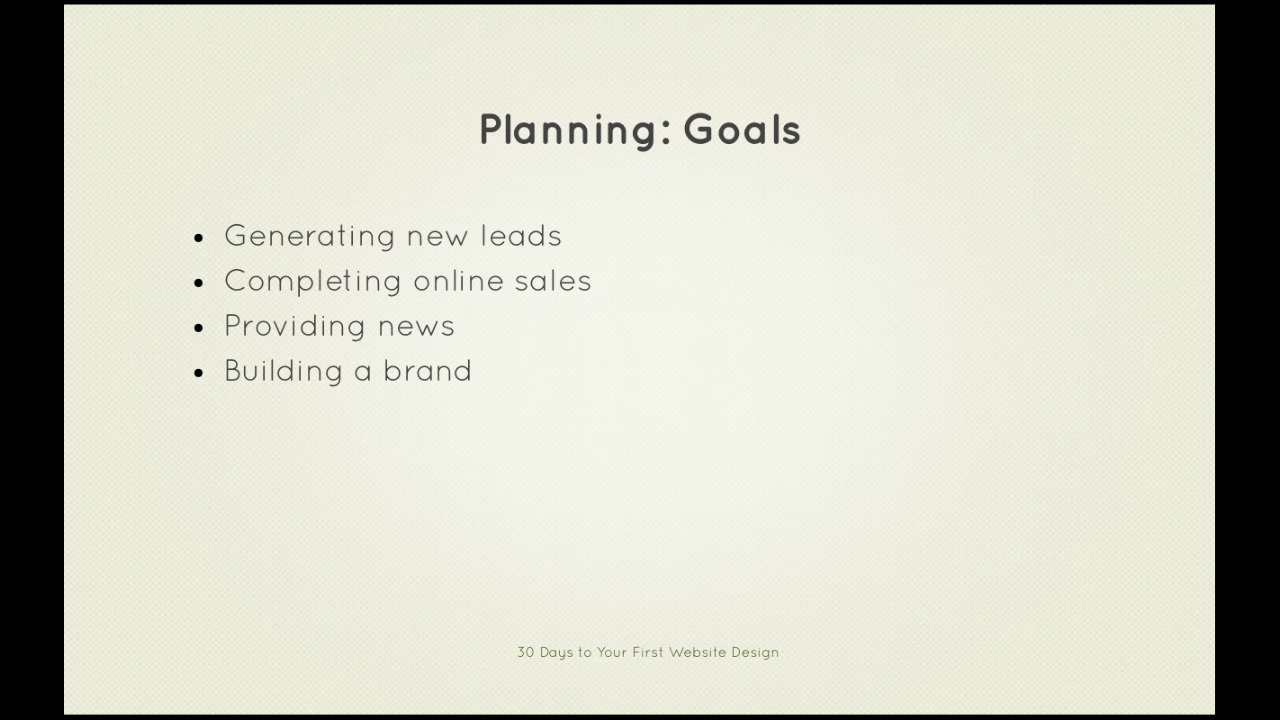
Generating new leads. In this case a site would be acting as a marketing tool – aiming to promote something, and gather responses from users. Success would be measured by the acquisition of new leads and new customers.
Completing online sales. eCommerce goals are fairly clear; the site exists to sell products and handle the purchasing. Success can be measured in terms of sales figures and cold, hard cash.
Providing news. Perhaps you’re focussed on a blog. Goals in this case would be to maintain high quality articles and reach as wide an audience as possible. You want people to read your material and hear your opinions. Success could measured by gathering of subscription numbers, via a newsletter, social followers, even paying members.
Building a brand. In which case consolidating the presence of a new or existing brand would be the business goal. Measuring the value of successful branding is difficult as it affects all aspects of business; solid identity sees all manner of gains within an organization. But one measurement of success could be the length of time users spend on your site.
The term “bounce rate” refers to the number of users visiting your site, but then leaving before exploring further. One goal when building a brand could be to minimize your site’s bounce rate.
Your site may also have secondary goals (even tertiary goals). If it’s an eCommerce project you’d ideally like to see people leave as happy customers, having completed a transaction. If those goals aren’t reached, you’d need to investigate why, but in the meantime you’d perhaps want some other goals to be achieved. You’d at least want visitors to remember your site, so them signing up to your newsletter would be a suitable secondary goal.
It’s important that we’re clear about our goals. Ambiguity will only lead to assumptions, then confusion, and perhaps even mess up working relationships.
Daniel Ritzenhaler hits upon a great technique in his A List Apart article on “Taking the Guesswork Out of Design.” He breaks down the setting out of goals into this simple equation:
> We want to __________ because ____________ so > that ___________.
Using this straight-forward formula removes any vagueness from your goals. Let’s apply it to one of our previous examples, the blog example: We want to write 5 quality blog posts per month because we want to be taken seriously amongst our peers so that we can build a community of followers.
See how well that cleared things up?
Goal Achievement
Moving on to some more additional reading, let’s look at goal achievement. Google analytics offers some great methods for measuring successful goal conversion, and we’ll be covering analytics later in the series. This article is one of mine and it looks at converting your goals. It goes into some detail about what conversion means, talks about optimizing conversion, then looks at using Google Analytics to help you track your goal achievements.
Next Steps
It’s assignment again, so before you jump into the next video, I have a simple task for you to think about whilst you’re planning our corporate website. I want you to think of our client’s primary goal, and place it into context as we did earlier with the blog example:
“We want to __________ because ____________ so that ___________.”
Have fun!
Next time on 30 Days to Your First Website Design, we’re going to start looking at Design Concepts. This is Ian Yates, and from all of us here at Tuts+, thanks for listening!
1.Introduction
1.1Introduction02:44
1.2What is Web Design?06:01
1.3Usability06:07
1.4Content05:20
1.5Goals05:27
2.Planning
2.1Three Don'ts of Design Theory02:48
2.2Inspiration05:45
2.3Style and Theme06:05
2.4Conceptual Sketching11:12
2.5Designing with Grids09:01
2.6The Anatomy of a Webpage05:44
2.7Whitespace05:03
3.Design Concepts
3.1Backgrounds and Textures10:18
3.2Navigation08:31
3.3Web Typography09:12
3.4Features Section16:04
3.5Contact Form12:25
3.6Footer Section09:05
3.7Prepping Your Design05:23
4.Site Elements
4.1Sprite Sheets14:07
4.2Project Organization04:47
4.3Code Editors14:45
4.4Web Standards Model16:25
4.5Semantics14:36
5.Prepping Your Design
5.1Further into CSS12:49
5.2Browsers16:50
5.3Behavior: jQuery slideshow12:43
5.4Form Validation13:23
5.5Cross Browser Testing11:21
5.6Google Analytics07:25
6.Conclusion
6.1Conclusion00:48





